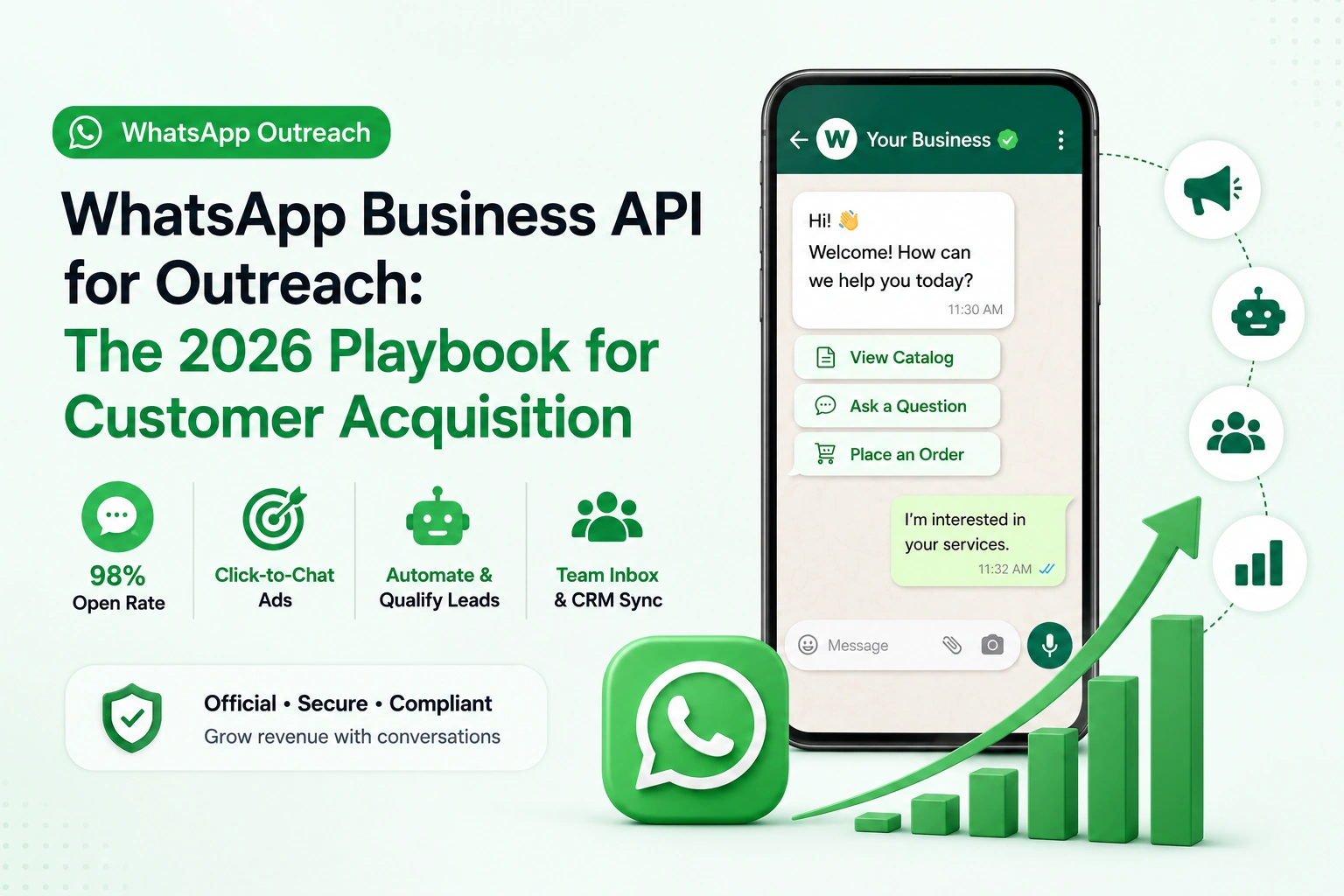
Your customers live on WhatsApp. Here’s how the official WhatsApp Business API turns the world’s most-used messaging app into a measurable acquisition channel — without the spam, the guesswork, or the surprise bans.
Category: WhatsApp Outreach· 7 min read
Key takeaways
- The WhatsApp Business API is Meta’s official channel for sending and automating messages at scale — broadcasts, chatbots, and two-way conversations.
- WhatsApp messages see open rates near 98% and reply times in minutes, which is why outreach lands.
- Click-to-WhatsApp ads turn a paid click into a live conversation and a captured lead in one step.
- Bans come from spam and unofficial tools — not from compliant API use with proper opt-ins.
- In India, you can pay ₹48,000–₹2,00,000+ a year for these features, or run the same stack on one flat plan.
What is the WhatsApp Business API?
The WhatsApp Business API is Meta’s official interface that lets a business send and receive WhatsApp messages through software instead of a phone screen. It’s built for companies that need to reach thousands of customers, run automated chat flows, and connect WhatsApp to their CRM, ads, and website.
It’s a different product from the free WhatsApp Business app. The app is fine for a solo shop replying by hand. The API is what you reach for the moment outreach becomes a system: scheduled broadcasts, a chatbot that qualifies leads at 2 a.m., a shared inbox where five agents work the same queue, and analytics that tell you what actually converted. Crucially, the API runs through Meta’s verified ecosystem, so your number stays compliant and your customers see a legitimate business — often with the green verified tick.
Why WhatsApp earns a place in your outreach mix
WhatsApp works because people read it fast. Messages get opened in minutes, replies feel personal, and conversations happen in real time.
The numbers are strong: open rates near 98%, click rates of 45–60%, 2.6B+ active users, and average reply times measured in minutes. It’s not a replacement for email — email still owns long-form nurture, newsletters, and detailed follow-ups — but for fast, conversational outreach, WhatsApp is hard to beat. The best stacks run both: email for depth, WhatsApp for immediacy.
On WhatsApp, your message lands in the same thread people use to talk to friends and family. That context does the heavy lifting: it builds trust, lowers friction, and makes a two-way conversation feel natural instead of intrusive.
What you can actually do with it
The API isn’t one feature — it’s an outreach toolkit. The pieces that move revenue:
- High-volume broadcasts. Push offers, launches, and reminders to your full opted-in audience using approved templates — delivered in seconds.
- No-code chatbots. Build flows that greet, qualify, answer FAQs, share a catalog, and route hot leads to a human — without writing code.
- Click-to-WhatsApp ads. Run Meta ads where the button opens a chat instead of a landing page, so a click becomes a conversation and a captured contact instantly.
- Shared team inbox. Let your whole team work one WhatsApp queue with smart routing, so no lead sits unanswered.
- CRM & webhook integrations. Sync every conversation, tag, and conversion back to your stack so attribution isn’t a guess.
How a WhatsApp outreach flow actually works
A working WhatsApp funnel does four things in order: capture the lead, let it qualify itself, nurture automatically, then hand the warm ones to a closer.
Picture a click-to-WhatsApp ad. Someone taps it and a chat opens — that’s capture, and you now have a contact, not an anonymous click. A chatbot greets them and asks a couple of questions; based on the answers, the lead sorts itself into “ready,” “researching,” or “not now.” That’s qualification, done at scale without an agent involved. The researching leads get a light, well-timed drip — a case study here, an offer there. That’s nurture. And the moment someone signals intent, they’re routed to a human in the team inbox to close. The AI handles volume; your people handle the deals worth their time.
Staying compliant and protecting your number
Compliant outreach on the official API rarely triggers bans. Problems come from unsolicited messaging, ignored opt-ins, and unofficial “grey” tools that piggyback on personal accounts.
Be honest about what the official API does and doesn’t promise. It doesn’t make you immune to consequences — nothing does. What it gives you is a defensible setup: you send through Meta’s sanctioned channel, you message people who opted in, you use approved templates, and you keep an eye on your quality rating. Do that, and Meta has little reason to act. The rule of thumb: relevance plus consent equals safety. Treat the inbox as a place you’ve been invited into, and it stays open.
The pricing reality in India
Most Indian WhatsApp platforms charge ₹48,000 to over ₹2,00,000 a year, and several add a markup on every message template on top of Meta’s own rates.
The features above have become table stakes — broadcasts, chatbots, a team inbox, CRM sync. Yet pricing varies wildly, and a lot of the spread is plan-gating: the inbox is in one tier, AI automation in another, extra seats billed per head. Here’s how the common platforms compare against a flat, single-plan approach:
| Feature | wappCAST | AiSensy | WATI | Interakt | Gallabox |
| Annual cost* | ₹14,499 | ₹80,000+ | ₹85,000+ | ₹48,000+ | ₹2,12,000+ |
| No-code chat-flow builder | Yes | Yes | Yes | Yes | Yes |
| Team inbox + routing | Yes | Plan-based | Plan-based | Plan-based | Plan-based |
| Unlimited team seats | Yes | 5, then paid | Paid add-on | Plan-based | 6, then paid |
| AI automation, no add-on | Yes | Capped | Credit-capped | Plan-based | Plan-based |
| Zero template markup | Yes | Yes | ~20% | ~25% | Varies |
*Indicative annual platform pricing; figures change frequently — verify current plans before deciding. Meta’s per-conversation charges are separate and set by Meta.
The honest takeaway: you’re often paying lakhs not for better technology, but for the privilege of unlocking features one tier at a time. A flat plan with no feature restrictions and zero template markup changes the maths — especially if you broadcast at volume, where a 20–25% template markup quietly compounds every month.
Frequently asked questions
What is the WhatsApp Business API?
Meta’s official interface for sending and receiving WhatsApp messages through software at scale — powering broadcasts, chatbots, two-way support, and ad-driven conversations for growing businesses.
Will using the API get my number banned?
When you send on the official API, honour opt-ins, keep your quality rating healthy, and use approved templates, the risk is low. Bans typically stem from unsolicited messaging, spam complaints, or unofficial tools.
Can I broadcast to thousands of people?
Yes. The official API supports high-volume broadcasting to opted-in audiences via approved templates, with messaging limits that scale up as your quality rating and verification improve.
What is a click-to-WhatsApp ad?
A Meta ad whose button opens a WhatsApp chat instead of a landing page — turning a paid click into a live conversation and a captured lead in a single step.
Do I need technical skills to run this?
No. Modern platforms ship no-code chatbot and broadcast builders, so marketing and sales teams launch campaigns without developer help. Developer APIs are there if you want deeper integrations.
How much does the WhatsApp Business API cost in India?
Software platforms commonly range from ₹48,000 to over ₹2,00,000 per year, sometimes with per-template markups. Flat-plan options like wappCAST bundle the core toolkit at ₹14,499 per year with no template markup.
Turn WhatsApp into a revenue channel
Join 500+ businesses scaling outreach on the world’s most-used app. See it live in a 15-minute walkthrough — no credit card needed. Book a free demo.