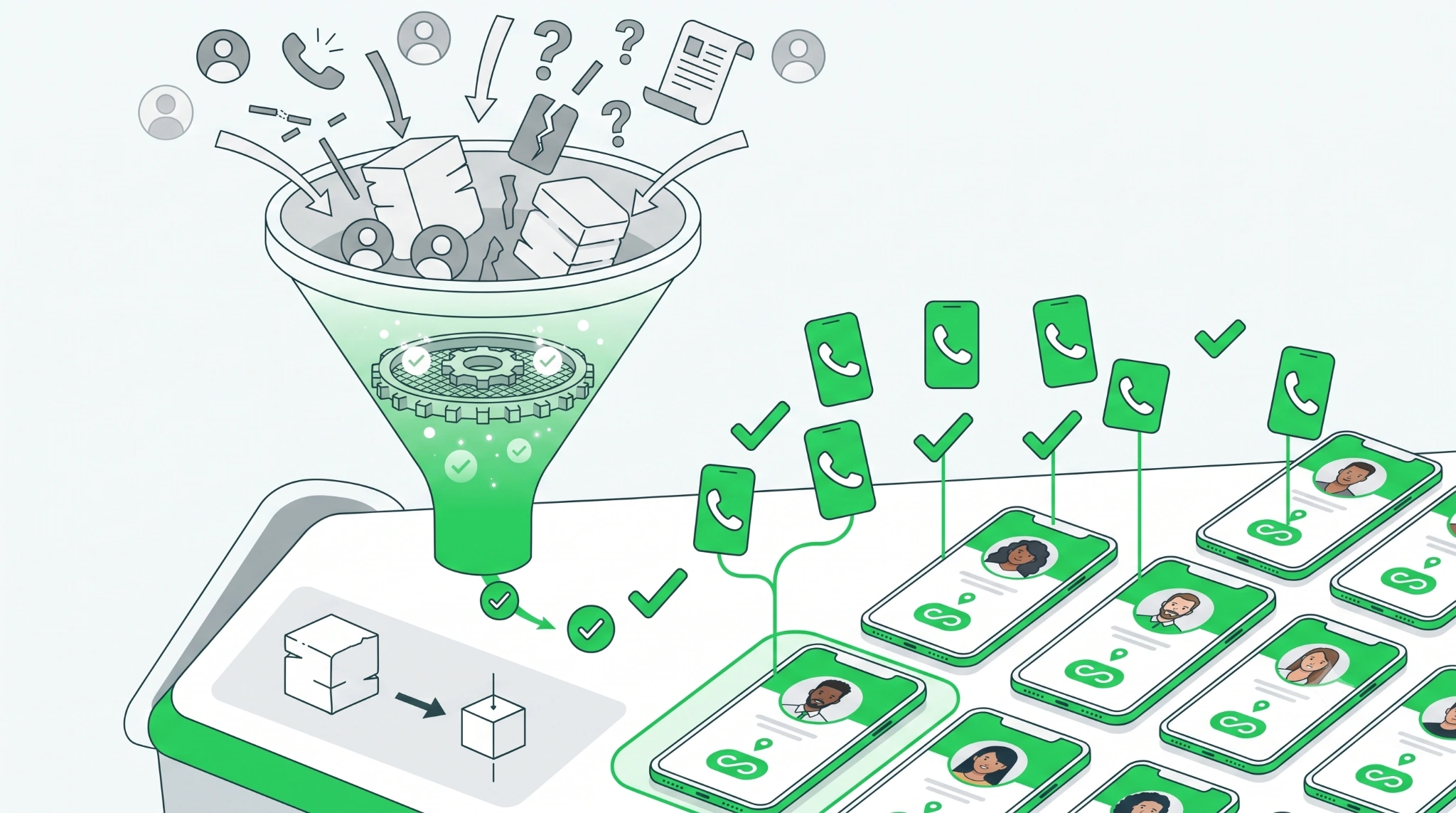
Most cold campaigns don't die because of a weak pitch. They die on contact one — the number's disconnected, the person left two years ago, or the record was scraped, resold, and passed around so many times it stopped meaning anything.
If your dialers aren't connecting and your WhatsApp messages aren't landing, the problem usually isn't your team. It's the B2B mobile data underneath them.
Quick answer: Fresh, verified B2B mobile data is contact data mined from public sources on an ongoing basis and run through a verification engine, so 90%+ of the numbers actually connect — unlike recycled lists that have been resold and left to decay.
Key takeaways
- Recycled, resold lists decay fast and bounce the moment you dial.
- Freshly mined data is pulled from public sources continuously and stays current.
- Verification is what turns raw numbers into a 90%+ connect rate.
- You don't need 100M contacts — you need the right few thousand, carved to your filters.
♻️ The recycled-list problem nobody wants to explain
Most companies calling themselves “data providers” aren't sources. They're resellers.
A list gets built once, sold, resold, repackaged, and sold again. By the time it reaches you, it's already been worked by a dozen other teams — and it's been decaying the entire way down the chain. B2B contact data goes stale fast: people switch jobs, companies fold, numbers get reassigned, direct lines get dropped.
So you buy “50,000 verified contacts,” load them into your dialer, and watch half of them bounce. The list was technically real. It just wasn't current. And current is the only thing that matters when you're trying to start a conversation.
What “freshly mined” actually means
Fresh data isn't a list someone dusted off. It's data pulled now, from sources that are meant to be public.
The honest version looks like AI systems scanning openly available places around the clock — business websites, public directories, listings, newsletters, forums, social profiles — and gathering contact details that were shared openly for business communication in the first place. Not private records. Not breach dumps. Publicly posted, traceable, B2B-intended information.
The difference is where it comes from. A resold list has no traceable origin — it just exists, passed hand to hand. Freshly mined data can point to where each record came from, and it gets refreshed continuously instead of frozen the day it was compiled.
✅ Mining is half the job — verification is the half that counts
Finding a number is easy. Knowing whether that number is alive is the hard part, and it's where most cheap data falls apart.
A real pipeline pushes every mined record through a verification engine before it ever reaches you. That step strips out the noise that quietly kills campaigns:
- Invalid and malformed numbers
- Duplicates
- Dead and disconnected lines
- Bots and inactive routing paths
What's left is the part you actually pay for: numbers that connect. When a provider talks about a “90%+ connect rate,” this is the mechanism behind it — not a promise, a filter. Mining gives you quantity; verification gives you reachability. You need both, but only one of them books meetings.
The data fields you should actually get
A usable file is more than a name and a number. Structured, campaign-ready B2B contact data typically includes:
- Full name
- Verified mobile number
- Location (for geo-targeting)
- Industry
- Company name
- Website
- Social links
- Employee size
- Revenue
Headcount, revenue, and industry are what let you segment before you spend a rupee on outreach. Good data doesn't just tell you who to call. It tells you who's worth calling.
🎯 You don't need 100 million contacts. You need the right few thousand.
A massive pool sounds impressive on a homepage. In practice, nobody runs a campaign to 100 million people.
The value isn't the size of the database — it's how precisely a slice can be cut out of it. From a large pool of decision-makers, the right approach carves out exactly the audience you're targeting: the right titles, industries, markets, and geographies. The people who sign off, not the gatekeepers in front of them.
That's the difference between buying a giant list and getting the right list. One fills your CRM with names. The other fills your calendar with calls.
Fresh vs. recycled B2B data, side by side
| What you get | Why it matters |
| Freshly mined, updated daily | No recycled, resold lists worked by ten other teams |
| 90%+ verified mobiles | Your dialers connect instead of bouncing |
| A large pool to source from | Your exact audience gets carved out of it |
| Built to your filters | You buy your slice — not the whole database |
| Traceable, public-source origin | You know where records came from |
❓ Frequently asked questions
What does “freshly mined data” actually mean?
It means contact records gathered from publicly available sources on an ongoing basis — then verified — rather than pulled from an old list that's been bought and resold multiple times. The data is current and traceable, not recycled.
How accurate are the mobile numbers?
The target is 90%+ connect accuracy. That comes from running every record through a verification engine that removes invalid, duplicate, dead, and bot numbers before the file reaches you — so a much higher share of your dials connect.
Can I check the data quality before I pay?
Yes. The right way to buy contact data is to see a sample first. A free sample file lets you test connect rates and field quality on your own before committing to anything.
How is this different from Apollo or ZoomInfo?
Large static databases refresh on their own cycles and give everyone the same records. Mined-to-order data is gathered and verified against your specific target and re-checked continuously — a freshly built, filtered slice rather than a shared, aging pool.
Is this data compliant to use?
Records are gathered from publicly available sources shared for business communication. As with any outbound program, you're responsible for aligning outreach with the regulations in your target markets (DPDP, GDPR, local calling/DNC rules). Fresh, traceable data makes that easier — but the compliance of your campaign is on how you run it.
The bottom line
Bad data kills campaigns before the first hello. Recycled lists are slow-acting poison: they look fine on a spreadsheet and fail the moment you dial.
Fresh, verified, filtered-to-order mobile data flips that. Mined daily. Verified to connect. Carved down to the exact audience you're chasing. It's the difference between a team that spends its day getting through — and one that spends it getting hung up on.
Want to see it before you spend anything? Get a free sample file and check the quality yourself.